Technology
3 min read
Salik Free Time in Dubai | Peak, Off-Peak & Free Hours
Last Updated On Wed Sep 30 2026
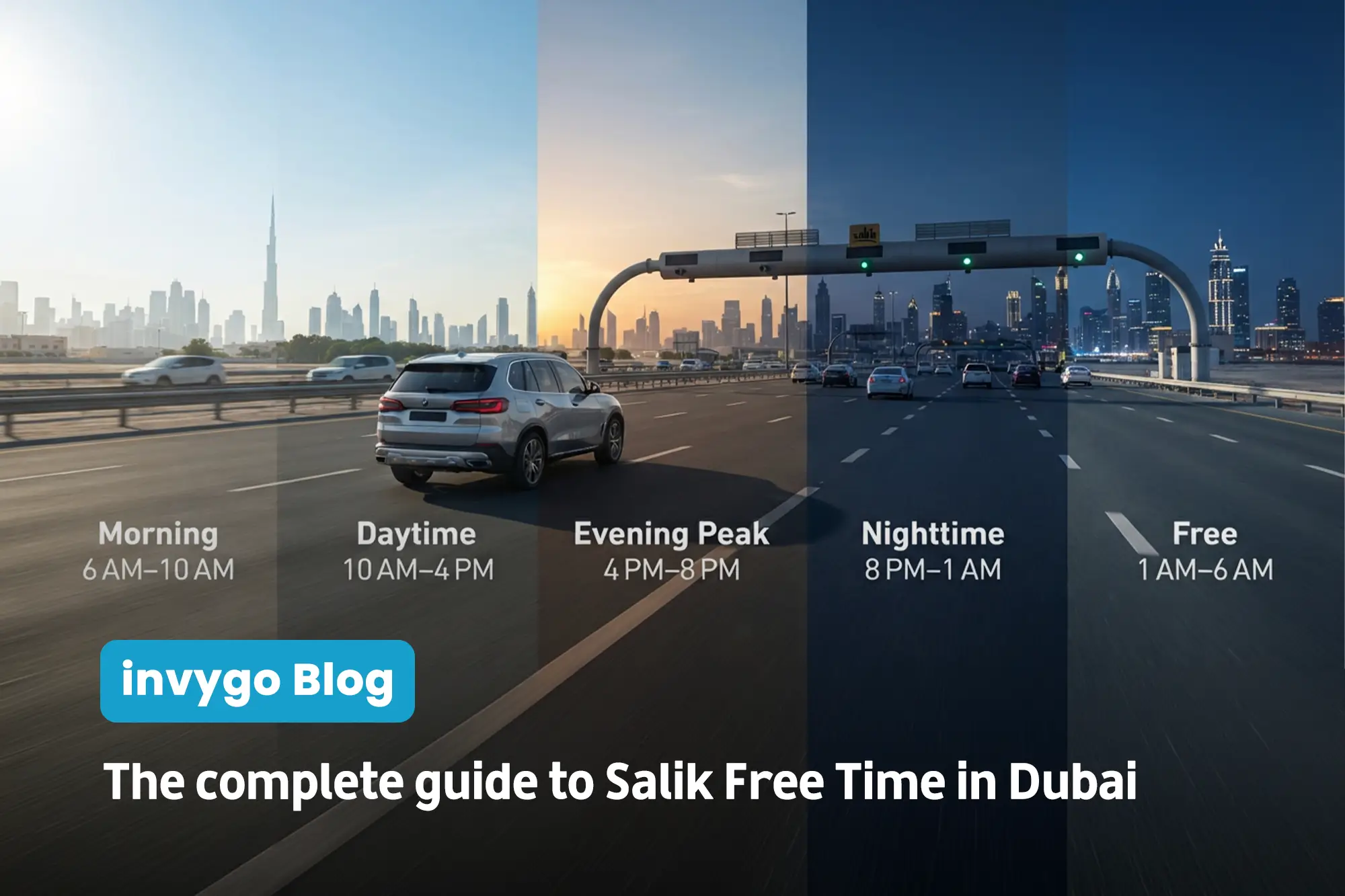
Starting January 31, 2025, Dubai's Salik toll system shifted to a dynamic pricing model to better manage traffic flow. Before this change, every Salik crossing cost a flat AED 4 regardless of the time of day — a system that had no pricing incentive for drivers to adjust their travel timing to reduce congestion. The new dynamic model, which remains in full effect throughout 2026, creates three distinct pricing bands — free, off-peak, and peak — that directly reward drivers who plan their journeys around Dubai's traffic patterns. For daily commuters in Dubai, understanding the Salik 2026 schedule is not a matter of curiosity — it is a matter of money. A Dubai resident who crosses two Salik gates twice daily during peak hours pays AED 24 per working day — AED 528 per month, assuming 22 working days. The same resident, if they cross during off-peak hours, pays AED 352 — a saving of AED 176 per month, AED 2,112 per year, just from timing their commute differently. For drivers who cross three or four gates daily, the saving potential is proportionally larger. This guide from invygo covers every dimension of Salik's 2026 timing schedule — regular weekday hours, Sunday rates, Ramadan adjustments, special holiday rules, all 10 gate locations, the common misconceptions that cost drivers money, and the practical strategies that smart Dubai commuters use to reduce their monthly toll bill.
Salik Timings 2026 — Monday to Saturday (Regular Schedule):
The standard Salik pricing schedule applies Monday through Saturday throughout 2026. It divides each 24-hour day into three periods — free, off-peak, and peak — based on historical traffic density data collected by RTA across Dubai's major road network. Here are the full details from invygo.
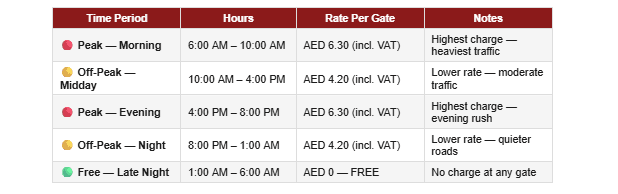
Note on VAT: Weekday Peak costs AED 6 (plus 5% VAT) and Weekday Off-Peak costs AED 4 (plus 5% VAT). The displayed amounts above include VAT. The RTA charges are AED 6 peak and AED 4 off-peak before VAT — the effective amounts deducted from your Salik account are AED 6.30 and AED 4.20, respectively.
The two peak windows — 6:00 AM to 10:00 AM and 4:00 PM to 8:00 PM — correspond to Dubai's established commuting patterns: the morning school and work rush and the afternoon-to-evening return journey. These are the windows where road demand is highest, and where the AED 6 rate creates the greatest incentive for flexible-timing drivers to adjust their journeys.
Are tolls free on Sunday in Dubai?
Sundays in Dubai come with a bit of relief for drivers. The Salik toll system charges a flat rate of AED 4 throughout the day, except for the early morning hours between 1 AM and 6 AM, when it is free
Salik Free Hours in Dubai 2026:
The Salik free window is the single most important timing fact for any Dubai driver looking to reduce toll costs — and it is worth understanding in complete detail.
The Daily Free Window: 1:00 AM to 6:00 AM
Salik is free from 1:00 AM to 6:00 AM every single day of the year. This five-hour window applies to all 10 Salik gates across Dubai. This means that every gate — Al Barsha, Al Garhoud Bridge, Business Bay Crossing, Airport Tunnel, all ten — charges zero between 1:00 AM and 6:00 AM, every day, without exception. No special conditions apply. No registration is required. No prior arrangement is needed. If your car passes through any Salik gate between 1:00 AM and 6:00 AM, AED 0 is deducted from your account.
Is Salik Free on Fridays?
Fridays are no longer completely free. The only guaranteed free window is 1:00 AM to 6:00 AM. Always verify the current RTA Salik schedule rather than relying on older information, since the system changed significantly in January 2025. Under the pre-2025 flat-rate system, Fridays had no special pricing — but they effectively cost the same as every other day at AED 4. Under the 2025 dynamic pricing system, Fridays follow the standard weekday pricing: peak AED 6 from 6:00 AM to 10:00 AM and 4:00 PM to 8:00 PM, off-peak AED 4 at other times, and free from 1:00 AM to 6:00 AM.
Is Salik Free on Public Holidays?
Salik is not free during public holidays. Variable toll pricing stays active across all holiday days: AED 6 during peak hours (6:00 AM–10:00 AM and 4:00 PM–8:00 PM), AED 4 during off-peak hours, and zero charge from 1:00 AM to 6:00 AM. All 10 Salik gates operate as normal throughout public holidays. This applies to UAE National Day, Eid Al Fitr, Eid Al Adha, and all other UAE public holidays. The 1:00 AM–6:00 AM free window always applies — but the rest of the day follows the standard variable pricing schedule.
Salik Ramadan Timings 2026:
During Ramadan, Salik adjusts its timing schedule to reflect the shift in daily routines — later sleeping, later working hours, and the Iftar and Suhoor patterns that change when Dubai's roads are busiest. Dubai's Salik system operates using variable toll rates to help manage traffic flow across the city. These timings are adjusted during Ramadan to reflect shorter working hours and changes in travel patterns.
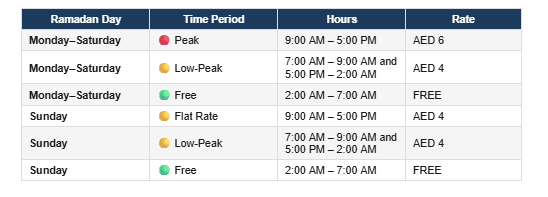
Key differences from the regular schedule during Ramadan:
The free window shifts from 1:00 AM–6:00 AM to 2:00 AM–7:00 AM — extended by one hour in both directions. The peak window shifts from 6:00 AM–10:00 AM to 9:00 AM–5:00 PM—reflecting later morning starts.
How to avoid Salik in Dubai?
-
Know Your Exact Gates and When You Hit Them Knowing exactly which gates you hit most frequently and at what times gives you the data to adjust your routes or timings intelligently. You might discover you're regularly hitting a peak window by just 10 minutes — a small schedule tweak could save you AED 50–100 per month. Check your Salik app transaction history to identify which gates appear in your account most frequently and whether those crossings fall in peak or off-peak windows.
-
Use the Free 1:00 AM–6:00 AM Window Strategically Airport runs, early-morning deliveries, late-night returns from inter-emirate trips — any journey that can be timed to arrive at Salik gates before 6:00 AM is toll-free. For early flight departures (5:00 AM–7:00 AM departures are common at Dubai International), departing home before 6:00 AM puts the Airport Tunnel crossing within the free window.
-
Shift Your Commute by 15–30 Minutes The morning peak starts at 6:00 AM. Drivers who leave home before 6:00 AM cross Salik at the free rate. Drivers who cross between 6:00 AM and 10:00 AM pay AED 6.30 per gate. A 5:45 AM departure versus a 6:15 AM departure is 30 minutes — for many Dubai residents, this is the difference between a free toll crossing and an AED 6.30 charge every working day.
-
Use the Al Maktoum Bridge. Between 10 PM and 6 AM Consider driving late at night or early in the morning and take advantage of the Al Maktoum Bridge and its toll-free period from 10 PM to 6 AM. The Al Maktoum Bridge on Umm Hurair Road provides a Bur Dubai–Deira crossing that is free during the off-peak and free windows — useful for drivers in Bur Dubai and surrounding areas who would otherwise pay at the Garhoud Bridge during daytime crossings.
-
Use Sunday for Multi-Gate Routes If your work schedule allows flexible days, planning multi-Salik-gate journeys on Sundays eliminates peak exposure. A Sunday journey through four Salik gates costs AED 4.20 per gate—AED 16.80 total—versus AED 6.30 per gate—AED 25.20 total—for the same journey on a Monday morning peak. AED 8.40 saved per trip, every Sunday.
-
Consider Alternative Routes During Peak Hours Some Dubai destinations can be reached via routes that bypass specific Salik gates. The Business Bay Crossing on Al Khail Road can sometimes be avoided by using the D71 (Al Meydan Road) for Business Bay–Nad Al Sheba journeys. Al Mamzar crossings on the Dubai–Sharjah corridor can sometimes be bypassed via the Sharjah–Dubai Expo Road depending on origin and destination. Not every bypass is faster, but during peak hours where traffic congestion is both costly and slow, an alternative route can save time and toll money simultaneously.
-
Enable Low-Balance Alerts and Auto-Recharge A low or zero balance can cost you AED 100 instantly plus AED 50 per day in penalties — far more painful than any toll. Set a low-balance alert on the Salik app or enable auto-recharge so you never fall below a safe threshold. Salik penalties for insufficient balance are disproportionately large relative to the toll cost. A driver who fails to maintain their balance may pay an AED 100 fine plus daily penalties — more in a single incident than weeks of normal tolls.
-
Share Trips During Peak Hours Carpooling: sharing rides during peak hours can split the cost among passengers, making travel more economical. Two colleagues commuting together from JVC to DIFC share the Salik cost — both directions, both gates — halving each individual's daily toll expense. UAE carpooling apps and communities make this increasingly practical for regular commuters on fixed routes.
-
Use Salik-Free Routes for Flexible Journeys Not every Dubai route passes through a Salik gate. Jumeirah Road (Beach Road) is toll-free. Emirates Road is toll-free. Al Khail Road has one gate (Business Bay Crossing) but can often be used partially without crossing it. Dubai Silicon Oasis and Academic City routes are generally Salik-free. For non-time-critical journeys — weekend shopping, leisure drives, visiting friends — slightly longer Salik-free routes can be more economical than shorter toll-bearing alternatives.
How invygo Subscription Cars Handle Salik in Dubai
For drivers using invygo's monthly car subscription, understanding how Salik applies to subscription vehicles is important:
-
Salik charges are the driver's responsibility — not included in invygo's subscription fee. All toll charges incurred during the subscription period are billed to the driver through the Salik account linked to the vehicle's tag.
-
Every invygo subscription car comes with a Salik tag pre-installed — drivers do not need to arrange separate tag installation or activation for subscription vehicles.
-
Salik charges appear on the driver's linked account or are billed through invygo's platform depending on the account setup — confirm the specific arrangement with invygo at the time of subscription.
-
The same free hours, peak timing, and off-peak strategies described in this guide apply equally to invygo subscription cars—subscription drivers benefit from all the money-saving strategies outlined above.
-
For drivers who want to avoid Salik costs entirely, invygo's monthly subscription is available for cars that can be used on Salik-free routes — the choice of route always remains with the driver.
-
invygo's all-inclusive monthly car subscription covers insurance, maintenance, and delivery — but toll charges (Salik) and traffic fines remain the driver's responsibility throughout the subscription period. Planning journeys using the free 1:00 AM–6:00 AM window, the Sunday flat rate, and off-peak timing strategies applies equally and can generate meaningful monthly savings for invygo subscribers who commute through multiple Salik gates.
Conclusion:
Salik's dynamic pricing system — active since January 31, 2025, and continuing throughout 2026 — rewards smart planning with meaningful financial savings. Understanding your commute's gate exposure, the timing of your crossings, and the five-hour daily free window gives every Dubai driver the tools to make genuinely informed decisions about when, where, and how they drive — and how much they spend doing it. Subscribe now monthly or weekly through invygo the smarter way to move and save more money